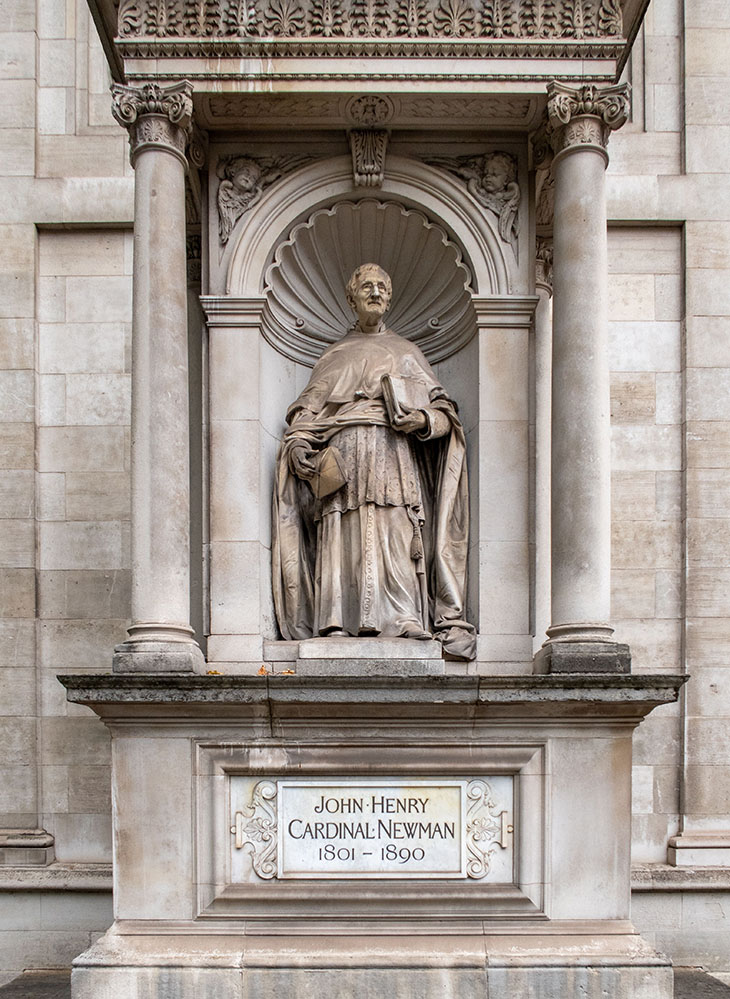
 On July 31, Pope Leo XIV announced that John Henry Newman (1801-1890), known more familiarly as Cardinal Newman, is to be declared a Doctor of the Church, and this officially happened at the Vatican on November 1, 2025. This is a much rarer event in Christianity than having canonizations. It refers to a recognition of the highly influential teachings of a man or woman, already viewed as a saint, on the faith life of the church. The word doctor means teacher. The rather short list of recognized teachers includes thirty-three men and four women: Hildegard of Bingen, Catherine of Siena, Teresa of Avila and Thérèse of Lisieux.
Newman’s story on the surface can be laid out briefly. He was the oldest of six children, all raised in the Church of England. One sister, nineteen-year-old Mary, dearest to him of the siblings, died prematurely, which devastated him. Another sister, Harriott, disowned him when he became a Roman Catholic in 1845 and an Oratorian priest in 1847, blaming him for her husband’s “Roman fever,” when in fact John successfully kept Tom Mozley from becoming RC. His sister Jemima remained a lifelong confidante. His two brothers, Charles (b.1802) and Francis (b.1805) never settled down and gradually disowned religion. Newman went to Oxford and as a fellow of Oriel College became an acknowledged theologian and writer until he felt compelled to leave the Established Church for Rome.
In 1859 he came under a Vatican cloud. His essay, “On Consulting the Faithful in Matters of Doctrine,” in a progressive periodical—ideas utilized at Vatican II—was denounced as heresy. There Newman lingered until a popular novelist wrote that Newman’s writings encouraged priests to lie. How could Newman refute the charge if whatever he wrote could be thought another lie? Instead, he produced a history of his religious thoughts, using letters to and from Anglican colleagues that became the Apologia, an autobiography that rivaled St. Augustine’s Confessions in power. His stature among British people, lost in 1845, was restored in 1864. His Apologia won the respect of fair-minded Anglicans for his fellow Catholics and for himself.
Thereafter Newman became the champion for a progressive Catholicism, English in style and opposed to the rigidity of an ultra-conservative variety under Pope Pius IX, especially the Italian style in England espoused by the Archbishop of Westminster, Henry Manning. In 1879, the new pope, Leo XIII who liked and trusted him, made Newman a cardinal in his very first consistory, and the cloud was forever lifted from him.
Newman’s theological writings are vast and rich, found in 39 books and in over 20,000 letters in the manner Victorians wrote letters—long and very thoughtful. I will select one feature of his characteristic way of thinking about religion that is sadly lacking in divisive polemics today: his aim for civility and for the balancing off of competing perspectives, much like Pope Francis’s aim for a Catholic Church synodal in style.
Newman had the utmost respect for church authority but he defended free theological investigation. “Life has the same right to decay, as it has to wax strong. This is specially the case with great ideas. You may stifle them…or you may let them have free course and range, and be content, instead of anticipating their excesses, to expose and restrain those excesses after they have occurred.” Church authority needs to restrain witch-hunts.
He balanced being a loyal British citizen—he was a Tory to the hilt—and being a loyal Catholic. He was always ready to back away from a position if his bishop insisted. He valued celibacy and esteemed, as well, the married life. Many of his letters are to married Catholics supporting them in their faith and in their demanding lives. He balanced being an object of hostility or suspicion with an unbounded trust in God’s Providence. Providence, in fact, is the leitmotif of his spirituality. “Lead, Kindly Light, amidst th’encircling gloom, Lead Thou me on…I do not ask to see the distant scene; one step enough for me.”
Nothing beats reading Newman himself. His words mesmerize. I conclude with three examples. “In a higher world it is otherwise, but here below to live is to change, and to be perfect is to have changed often” Development. of Doctrine, 40. “[Be] content to wait, knowing that error is like other delinquents; give it rope enough, and it will be found to have a strong suicidal propensity” Idea of a University, 476. “Logicians are more set upon concluding rightly, than on right conclusions….man is not a reasoning animal; he is a seeing, feeling, contemplating, acting animal” Grammar of Assent, 94.
Edward Jeremy Miller. Emeritus Professor of Religion
Gwynedd Mercy University
Houston Catholic Worker, Vol. XLVI, No. 1.