Artist: Rita Corbin
“Make me an instrument of Your peace. Where there is hatred let me sow Your love.” This well-known prayer, attributed to St Francis of Assisi and repeated so often that it may seem hackneyed, deserves our renewed and deep attention. We are in the midst of the Jubilee Year of St Francis and also in the midst of a war in the Middle East. How should we respond? What does our faith demand of us?
Recently, numerous Catholic leaders, including Pope Leo XIV, Cardinal Blase Cupich and Cardinal Robert McElroy, have raised grave concerns about the war with Iran. Archbishop Paul Coakley, president of the US Conference of Catholic Bishops, issued a statement on behalf of the bishops calling for a “halt to the spiral of violence and a return to multilateral diplomatic engagement.” Coakley warns that the “growing conflict risks spiraling into a wider regional war…and the possibility of a tragedy of immense proportions.”1
In 1983, in The Challenge of Peace: God’s Promises and Our Response, A Pastoral Letter on War and Peace, the United States Conference of Catholic Bishops addressed teachings on modern warfare. Catholic teaching, they said, recognizes two “distinct but interdependent methods evaluating warfare”: the “just war theory” and the way of non-violence (#120).2 The pastoral letter ultimately suggests the differences between adherents of complete pacifism and the just war theory may be narrowing. The immense destructive potential of modern weapons and the consequent increase in the horrors of modern warfare, may make it almost impossible to satisfy the requirements of the just war theory (#120). We have arrived at what the bishops call “a new moment” in our approach to the morality of war (#126).
The just war theory begins with the assumption that war is an evil to be avoided. The bishops state it “begins with the presumption which binds all Christians: we should do no harm to our neighbors” (#80). This presumption can only be overcome in the most extreme circumstances. The just war theory outlines 7 conditions that must be met before it is justified to take up arms.
Before a nation can justly go to war, the following conditions must all simultaneously be satisfied:
- Just Cause: The cause must be just, such as to protect innocent life or to secure basic human rights. “As both Pope Pius XII and Pope John XXIII made clear, if a war of retribution was ever justifiable, the new risks of modern war negate such a claim today (#86).
- Competent Authority: War must be declared by those with authority. “Some of the bitterest divisions …have been provoked over the question of whether or not a president of the United States has acted constitutionally and legally in involving our country in a de facto war, even if – indeed especially if—war was never formally declared” (#88).
- Comparative Justice: Do the rights and values involved justify killing? (#92).
- Right intention: “During the conflict, right intention means pursuit of peace and reconciliation, including avoiding unnecessarily destructive acts or imposing unreasonable conditions (e.g. unconditional surrender)” (#95).
- Last resort: a war is not justified until all peaceful alternatives have been exhausted (#96).
- Probability of success: It is not a hopeless cause (#98).
In addition, even if the above conditions are met, there are two more requirements for conduct during the war: proportionality and discrimination.
- Proportionality: “The damage to be inflicted and the costs incurred by the war must be proportionate to the good expected by taking up arms” (#99)
“When confronting choices among specific military options, the question asked by proportionality is: once we take into account not only the military advantages that will be achieved by using this means but also all the harms reasonably expected to follow from using it, can its use still be justified? (#105).
- Discrimination: The discrimination requirement “prohibits directly intended attacks on non-combatants and non-military targets” (#107). It also requires us to ask ourselves “how many deaths of non-combatants are “tolerable” as the result of indirect attacks…” (#109).
Recently Church leaders have relied on just war reasoning to challenge the propriety of entering the current war with Iran. Cardinal Robert McElroy, in an interview with Catholic Standard, quoted Pope Francis who said, “Every war leaves the world worse than it was before” and said that the current war does not meet the threshold of the just war theory and is therefore not morally legitimate. First, he said, since United States was not responding to a verifiable attack or imminent threat, just cause does not presently exist. “As Pope Benedict declared categorically, Catholic teaching does not support preventative war,” he said. Secondly, the war fails to meet the criteria of right intention, he said, particularly because the goals of the war have been unclear: Various goals have been asserted in quick succession, including destruction of Iran’s weapons capability, regime change, building a democracy and unconditional surrender. To have a right intention, you must have a clearly stated intention from the outset, the Cardinal said. Thirdly, McElroy states, “it is far from clear that the benefits from this war will outweigh the harm that will be done, especially given the political instability in the Middle East, the expansion of the war into neighboring countries, the strain on the world’s oil supply and the possibility of immense casualties on all sides.”3
While Cardinal McElroy warns that the initiation of the war is not morally justified, others have challenged the way the war is being conducted. In setting out the just war criteria in their 1983 Pastoral Letter, the US bishops have written, “[T}he possibility of taking even one human life is a prospect we should consider in fear and trembling” (The Challenge of Peace #80). Yet the White House has posted on X a video of actual war footage intermixed with clips of video games and action movies, in what has been termed “gamifying” the war. In response, Cardinal Blase Cupich said that it dishonored the “real death and real suffering” of human beings who are affected. “We lose our humanity when we are thrilled by the destructive power of our military … we become desensitized to the true costs of war.” 4
There are also serious concerns about whether enough is being done to avoid killing non-combatants, especially after a strike on an Iran school in which 175 people, mostly children, were killed by a US-made missile. The Pentagon is closing the Civilian Harm Mitigation and Response Office, which works to mitigate risks to non-combatants, and the Civilian Protection of Center of Excellence which provides training in mitigating such harms. Defense Secretary Pete Hegseth has repeatedly rejected what he calls “stupid rules of engagement,” and (in a much-quoted phrase) endorsed “maximum lethality, not tepid legality” and “violent effect, not politically correct.” Such callous disregard for potential harm to non-combatants is shocking, morally insupportable, and inconsistent with just war criteria.
Of course, just war theory is not the only means of evaluating the conflict with Iran. Analysis from the point of view of Christian pacifism also leads us to reject the morality of the war against Iran.
In The Challenge of Peace, the USCCB acknowledged that for the past 1500 years, the just-war teaching has been the predominant teaching. However, the complete refusal to participate in violence has been present among Christians since the time of Jesus. “Moved by the example of Jesus’ life and by his teaching, some Christians from the earliest days of the Church committed themselves a non-violent lifestyle. Some understood the gospel of Jesus to prohibit all killing,” (#111) the bishops wrote. They cited, among others, St Francis of Assisi, Dorothy Day and Martin Luther King as witnesses to this faith-based response to violence.
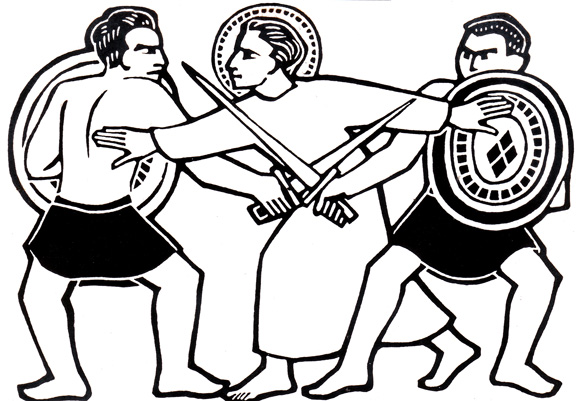
Saint Telemachus, Peacemaker
Artist: Ade Bethune
From its inception, the Catholic Worker Movement has been strongly and consistently aligned with the way of non-violence. During the Second World War, there was strong backlash against the movement due to its unpopular position.
In January 1942, Dorothy Day wrote an article for The Catholic Worker entitled Our Country Passes from Undeclared War to Declared War: We Continue our Christian Pacifist Stand. She must have anticipated the hostile response she would receive. She begins the article by saying, “Lord God, merciful God, our Father, shall we keep silent, or shall we speak? And if we speak, what shall we say?” She writes emotionally and her words are a lament. She writes that we have forgotten so much and she decides she must remind her readers of Jesus’ injunction to love one’s enemies and do good to those who hate you and to recall for them St Francis, who spoke of and worked for peace. She writes, “We love our country and we love our President…[but] we have failed as Americans to live up to our principles.”
Then she announces, “We are still pacifists. Our manifesto is the Sermon on the Mount, which means we will try to be peacemakers. Speaking for our conscientious objectors, we will not participate in armed warfare or in making munitions, or by buying government bonds to prosecute the war, or in urging others to these efforts.”5
It is not hard, after reading these words to imagine Dorothy Day’s response to the current military action.
Whether relying on the just war theory or the path of Christian pacifism the conclusion is the same. Pope Leo XIV has called for an immediate cease fire and decried the atrocious violence of the war, warning that violence would not bring the justice, stability and peace that the peoples of the region long for.
- Statement of Archbishop Coakely , March 1, 2026. https://www.usccb.org/news/2026/archbishop-coakley-echoes-pope-leo-xivs-appeal-renewed-dialogue-amid-rising-tensions
- The Challenge of Peace: God’s promise and Our Response, A Pastoral Letter on War and Peace, National Conference f Catholic Bishops, May 3, 1983.
- “In Interview, Cardinal McElroy says U.S. entry into war with Iran ‘not morally legitimate,” citing Catholic just war teaching,” Catholic Standard, March 9, 2026.
- Statement of Cardinal Blase J.Cupich, archbishop of Chicago, “A Call to Conscience”, March 7, 2026.
- “Our Country Passes from Undeclared War to Declared War; We Continue Our Pacifist Stand, The Catholic Worker, January 1, 1942.
Houston Catholic Worker, Vol. XLVI, No. 2, April-June 2026.