Version 1.0.0
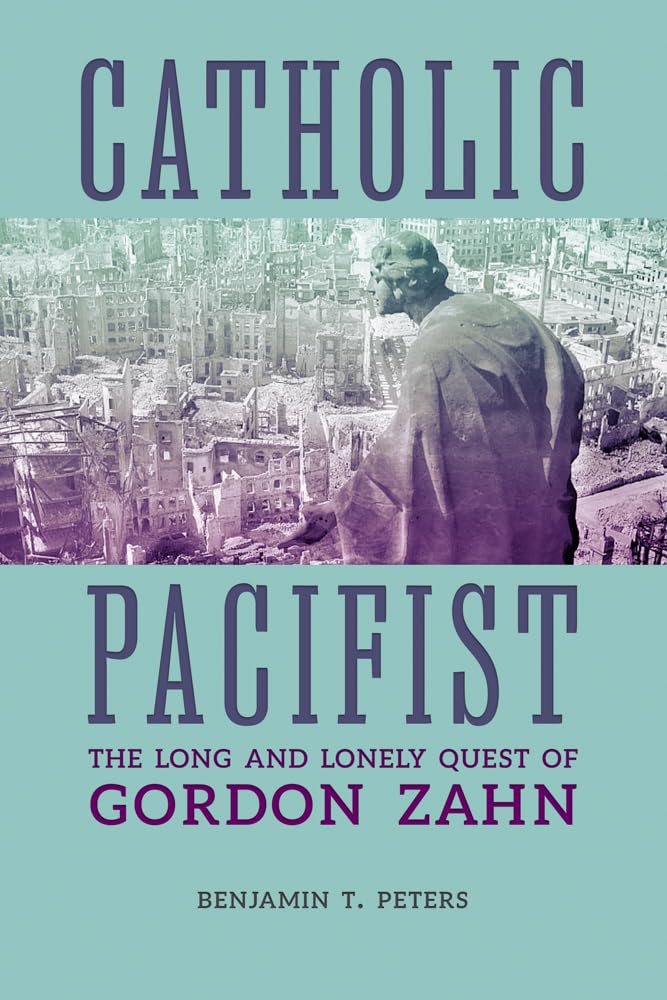
A century ago, the label “Catholic Pacifist” was a contradiction in terms. But this contradiction broke down over the course of the twentieth century, thanks to Catholic advocates for peace such as Pope John XXIII, Dorothy Day, Thomas Merton, Jim Douglass, Daniel Berrigan, and Gordon Zahn, a relatively unknown and largely forgotten figure—until now, thanks to this well-researched, well-written, and insightful intellectual biography by Ben Peters. It is required reading for understanding the developments in the Catholic Church’s teaching on war and peace in the twentieth century.
Zahn was born the year the Great War ended. Raised in Milwaukee as a devout Catholic, he had a strong sense early on of the importance of Jesus’ teaching on peace. His pacifist impulses grew in the late 1930s as the world marched headlong into another war. He was budged out of the undergraduate program at St. John’s in Collegeville for voicing his pacifist convictions.
Zahn first encountered Dorothy Day by reading The Catholic Worker, but he met her in person as a resident of Camp Simon, the alternative service site for Catholic COs during World War II, named after the Cyrenian who carried the cross for Jesus. Day visited the camp to support the group, shoring up their spirits by extolling their crucial witness to Christ in a time of war. It was at Camp Simon that Zahn found himself part of emerging tradition in the Church, the Catholic peace tradition.
After World War II, Zahn entered the Ph.D. program in sociology at Catholic University to study with Fr. Paul Hanly Furfey. Furfey’s “supernatural sociology” enabled Zahn to develop a method that challenged both the overly rationalistic approach of Catholic neo-scholasticism and the supposedly value-free methods of the secular field of sociology. Peters’ account is especially insightful on this score. It shows how Zahn carved out an approach that was at once theological and empirical, dedicated to a Gospel-shaped mode of social analysis and action.
The fruits of this approach emerged with Zahn’s study of Catholic compliance to the militarism of the Nazi regime, later published as German Catholics and Hitler’s Wars. Zahn employed the tools of sociology to analyze how Catholics, especially bishops, led their flocks to acquiesce in the depredations of those barbaric years. Only “maladjusted” Catholics resisted the dynamics of nationalism and refused to give allegiance to the Fatherland and the Fuhrer.
While researching German Catholics, Zahn discovered the story of the Austrian resister-martyr Franz Jägerstätter. He interviewed his widow Franziska and friends and neighbors from the village of St. Radegund, unearthed other relevant documentation, and wrote it up into a book called In Solitary Witness: The Life and Witness of Franz Jägerstätter (1964). It was Zahn’s most notable achievement, not only for its pathbreaking scholarship, but also for its message to a generation of peacemakers in the United States and Europe. Merton and Berrigan wrote about it. Bishop Thomas Roberts of Bombay, India, was so inspired by the story that he brought it into the deliberations at Vatican II.
In both books, and other books and essays besides, Zahn made it clear that the Church, by defending the authority of the state on matters of war over individual conscience, rendered itself complicit in the Nazi horrors. And in doing so, he showed that the same argument was rendering the Church complicit in US-manufactured horrors. For this, he was branded a “sectarian,” the label just-war theorists used to dismiss his position as unreasonable and irresponsible. In fact, Zahn was dismissed by critics across the board: the passive-aggressive faculty at Loyola Chicago, the hawkish Bishop Hannan who took a pro-nuclear stance at Vatican II, the liberal labor priest Msgr. George Higgins, and many others. In the Cold War setting, Jesus’ teaching on peace rankled Catholic Americanists bent on defending “Christian civilization.” Plus ça change . . .
By the 1970s, Zahn encountered a new set of critics: Catholics in the peace movement who scorned Church teaching on sexual morality, abortion, and liturgy. Like Dorothy Day with whom he commiserated by letter on these matters, Zahn held to a traditional line amid the post-conciliar confusions. At the same time, he challenged Catholic conservatives and liberals on their support for the US involvement in Vietnam War and the arms race. Opposition from many sides made for “the long and lonely quest” to which Peters refers in his subtitle. But it also made for a deep respect that Zahn gained over the years, earning for him the unofficial title of “dean of the Catholic peace movement.” For this reason, the Catholic bishops’ committee drafting the pastoral letter on nuclear weapons called on Zahn to explain his pacifism. The 1983 Pastoral Letter failed to endorse it of course, but it did designate pacifism as a “tradition” in the Church, constituting a vindication of Zahn’s life-long work.
Zahn’s later years were focused on his primary concern: supporting conscientious objectors to war. At U Mass-Boston he set up the Center on War and Conscience to pursue his pastoral approach to peacemaking, working with people, civilians and military, facing the prospect of waging war and struggling to discern their consciences in the light of eternity. It was a pastoral approach rooted in Christ’s gift of peace. Peters has provided a way to understand that gift in a book that is itself a gift to those pursuing a traditionally Catholic, yet radical form of peacemaking. As we move further into this century, may Zahn’s quest—still long, but thanks to him, not quite so lonely—inspire more generations of peacemakers to carry on his scholarly and pastoral work.
Michael Baxter is Associate Professor of the Practice at the McGrath Institute for Church Life at the University of Notre Dame.
Houston Catholic Worker, Vol. XLVI, No, 4. October-December 2026.