When we heard that Pope Leo XIV had given his approval for John Henry Newman to be made a Doctor of the Church, I looked to Dorothy Day ‘s writings for her perspective on Newman and how this momentous decision relates to the Catholic Worker movement.
The references I sought were found in her diaries, published by Orbis Press as The Duty of Delight. There she recommends Louis Bouyer’s book, Newman: His Life and Spirituality (newer reprint available from Ignatius Press). Dorothy said the book was tremendous, after reading it in its entirety.
So with Dorothy’s endorsement, we began reading Bouyer’s Newman. Mark Zwick had told me about Newman’s leadership in the Oxford Movement, his study of the Fathers of the Church and Christian antiquity. He studied the Via Media, hoping to find the answer to his search for a contemporary manifestation of the Church of Christian antiquity within the Anglican Church. Periodically, over the last two centuries, groups within the Anglican Church hoped that the Via Media might be a solution for their search for a living model of the early Church. Ultimately, Newman’s pastoral and theological studies brought him to disappointment in the Via Media. His journey eventually led to his entry into the Catholic Church, even though he had been surrounded by prejudices, negative campaigns and persecutions against Catholics there in England.
During his spiritual and theological journey, Newman gathered many scholars to discuss with him the quest for the authentic revitalization of the Christian Church in all its fullness. He wrote extensively theologically during this time, still an Anglican. Some of these works were published and discussed extensively in England. In fact, Bouyer contends that in some of these writings Newman laid the groundwork for the coming forth of the theology of the mystical body of Christ.
Newman, in seeking this path, received criticism from many sides. After centuries of splits and divisions, scholars and pastors found it difficult to find the living, pristine Church they sought. Newman struggled theologically and ultimately came to the conclusion that the only Church where these expectations might be filled would be the Catholic Church. Even though his impression of the Catholic Church had been informed by common prejudices of the day, he decided to take the step to become Catholic. When he announced that he had decided to join the Catholic Church, many of his colleagues were horrified and in fact there was so much criticism that he wrote a book explaining this decision, Apologia Pro Vita Sua.
I learned so much more about Newman’s spiritual and theological journey by studying Bouyer’s book.
The decision to make Cardinal Newman a Doctor of the Church is surely a sign of our Holy Father’s commitment to unity in the Church, a unity the Church needs so much at this time. Conservatives and liberals and those in between love and admire John Henry Newman.
Like many saints and cardinals, Newman suffered many criticisms during his spiritual and theological journey.
Tradition p. 183
As contemporary readers, we found fascinating the description that Bouyer gives of Newman’s treatise on Tradition in the Church.
There is much discussion in the Church today about so called “trads” and “non trads” and what is tradition. Is it in stone? Newman’s view of the matter:
“In this view of the matter, there are two forms, distinct yet inseparable, in which Tradition may be manifested. One of these forms he calls ‘episcopal Tradition’; the other ‘prophetical Tradition.’ The former consists of the official formularies of the hierarchy, such as the several creeds. It is an addition to, and an interpretation of, the Scriptures, but it is itself something committed to writing and therefore fixed, bounded, and stereotyped. Its purpose is to conserve and to safeguard (page 183).”
“But prophetical Tradition is both living and life-giving. Not confined to any particular period of time, it is, like life itself, both one and manifold. It suffuses the writings of the doctors, the formularies and ritual of the liturgies, the continuous teaching of the Church, and the soul of Christians as it expresses itself throughout the whole of their existence. Sometimes it is almost identical with episcopal Tradition; sometimes it overflows all limits and tends to fade and disappear in fable and legend. Therefore, if episcopal Tradition were not at hand to clarify and define it, prophetical Tradition would always be in danger of being overlaid by corruption; whereas it is the living truth that dwells for ever in Christian souls and in the Church. Rather than any catalogue of dogmas and definitions, it is “what Saint Paul calls ‘the mind of the Spirit’, the thought and principle which breathed in the Church, her accustomed and unconscious mode of viewing things.”
The Catholic Worker and Tradition
As Catholic Workers, we were very interested to read of the prophetical tradition being one of the two essential forms of tradition. There are so many examples throughout the history of the Church of prophetical tradition. For example, there is St. Francis of Assisi who transformed the faith of the earth without firing a shot. We like to think that the Catholic Worker movement with Dorothy Day and Peter Maurin is an example of prophetic tradition. One can mention nonviolent peace movements and, on a small scale, so many projects that come from the Spirit all for the good of the human person and the common good. It appears we do not have to argue about who is traditional and who is not if we embrace the two forms that Cardinal Newman, doctor of the Church, presents.
We are printing here below some actual writing of Cardinal Newman for you.
Reference
Bouyer, Louis. Newman: His life and Spirituality. PJ Kenedy and Sons. 1958.
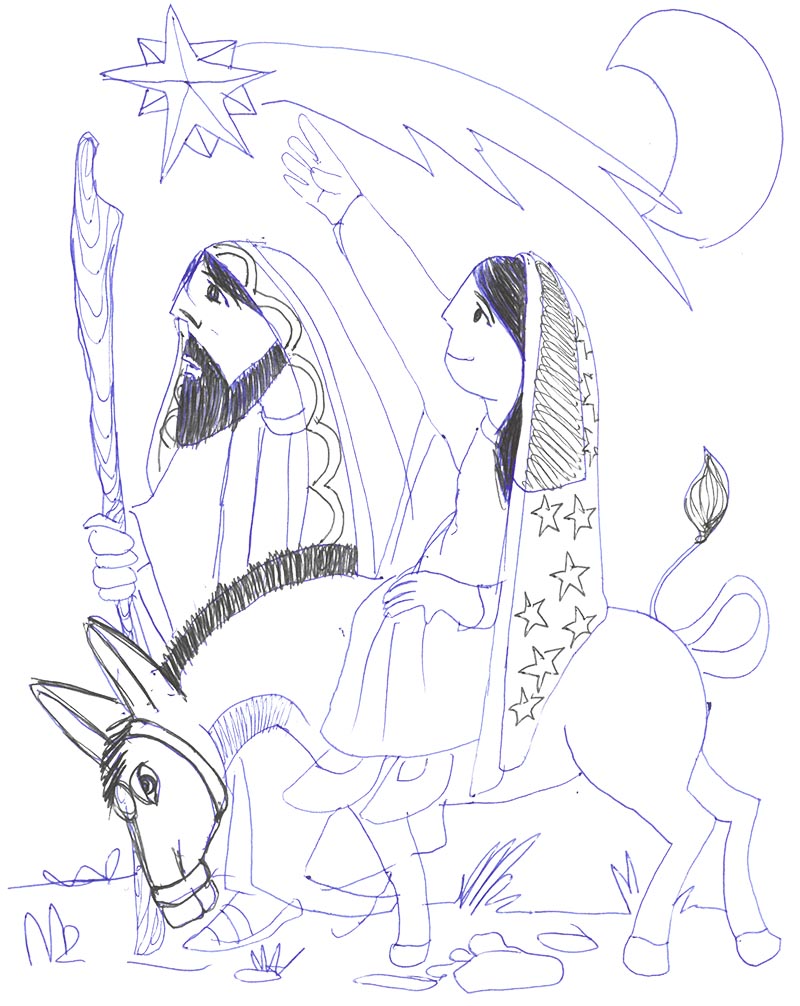
Christmas
by Angel Valdez
Cardinal Newman on the Incarnation
We published the following excerpt from a Newman sermon in the Houston Catholic Worker in November 2009:
His condescension in coming down from heaven, in leaving His Father’s glory and taking flesh, is so far beyond power of words or thought, that one might consider at first sight that it mattered little whether He came as a prince or a beggar. And yet after all, it is much more wonderful that He came in low estate, for this reason; because it might have been thought beforehand, that, though He condescended to come on earth, yet He would not submit to be overlooked and despised: now the rich are not despised by the world, and the poor are. If He had come as a great prince or noble, the world without knowing a whit more that He was God, yet would at least have looked up to Him and honored Him, as being a prince; but when He came in a low estate, He took upon him one additional humiliation, contempt,—being condemned, scorned, rudely passed by, roughly profaned by His creatures.
What were the actual circumstances of His coming? His Mother is a poor woman; she comes to Bethlehem to be taxed, travelling, when her choice would have been to remain at home. She finds there is no room in the inn; she is obliged to betake herself to a stable; she brings forth her firstborn Son, and lays Him in a manger. That little babe, so born, so placed, is none other than the Creator of heaven and earth, the Eternal Son of God.
Well; He was born of a poor woman, laid in a manger, brought up to a lowly trade, that of a carpenter; and when He began to preach the Gospel He had not a place to lay His head: lastly, He was put to death, to an infamous and odious death, the death which criminals then suffered….
And it is remarkable that those who were about Him, seem to have treated Him as one of their equals. His brethren, that is, His near relations, His cousins, did not believe in him. And it is very observable, too, that when He began to preach and a multitude collected, we are told, “When His friends heard of it they went out to lay hold on Him; for they said, He is beside himself.” [Mark iii. 21.] They treated Him as we might be disposed, and rightly, to treat any ordinary person now, who began to preach in the streets. I say “rightly,” because such persons generally preach a new Gospel, and therefore must be wrong… They had lived so long with Him, and yet did not know Him; did not understand what He was. They saw nothing to mark a difference between Him and them. He was dressed as others, He ate and drank as others, He came in and went out, and spoke, and walked, and slept, as others. He was in all respects a man, except that He did not sin; and this great difference the many would not detect, because none of us understands those who are much better than himself: so that Christ, the sinless Son of God, might be living close to us, and we not discover it…
Thus He came into this world, not in the clouds of heaven, but born into it, born of a woman; He, the Son of Mary, and she (if it may be said), the mother of God… This is the All-gracious Mystery of the Incarnation, good to look into, good to adore; according to the saying in the text, “The Word was made flesh,—and dwelt among us.” …
He came in lowliness and want; born amid the tumults of a mixed and busy multitude, cast aside into the outhouse of a crowded inn, laid to His first rest among the brute cattle. He grew up, as if the native of a despised city, and was bred to a humble craft. He bore to live in a world that slighted Him, for He lived in it, in order in due time to die for it.
He who loved us, even to die for us, is graciously appointed to assign the final measurement and price upon His own work. He who best knows by infirmity to take the part of the infirm, He who would fain reap the full fruit of His passion, He will separate the wheat from the chaff, so that not a grain shall fall to the ground. He our brother will decide about His brethren. In that His second coming, may He in His grace and loving pity remember us, who is our only hope, our only salvation!
(from Parochial and Plain Sermons: Sermons 16 and 13)