In order that he shall find God, the Christian is placed on the streets of the world, sent to the manacled and poor brethren, to all who suffer, hunger and thirst; to all who are naked, sick, and in prison. From henceforth this is his place; he must identify with them all… for it is the same way that God sent a Savior to us. (Todd Walatka, Von Balthasar and the Option for the Poor: Theodramatics in the Light of Liberation Theology, Catholic University of America Press)
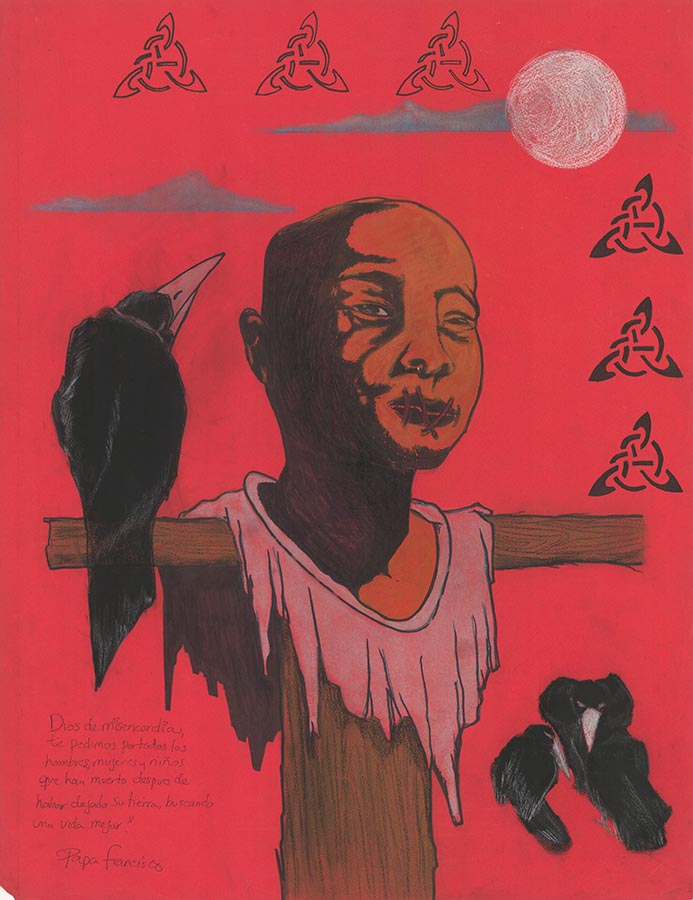
Artist: Angel Valdez
One would expect that the social and economic situation today should be very different from that of the 1930s when Dorothy Day and Peter Maurin started the Catholic Worker movement. Or different from difficult and turbulent times in other centuries. It was the Great Depression when the Catholic Worker movement began. The poor, the homeless, including new immigrant families, struggled even to survive. Threats against various groups, and threats of war resounded in the world.
It is striking to note the similarities in our time to that of the Depression. Dorothy Day wrote of the Robber Barons and contrasted their lives of extreme wealth with the lives of the poor. The “one percent” of wealthy and powerful today are the Robber Barons of yesterday. The contrasts in what is available to the average or poor person with that of the oligarchs are more than notable; the injustice of the economy is staggering. As during the Depression, even some young college graduates cannot find jobs.
The historical perspective does not help us to accept, but perhaps to perceive, the implication, of a world in which there are few funds to feed poor children and a lack of a desire to build an economy that will bring relief to struggling families, but billions are available to carry out massive deportations of people of color, and wage wars around the world.
In the face of current devastating realities, the serious question is how can the Gospel enter more into our lives and our culture today? What can we do when the patterns of our everyday lives often have little to do with the Gospel, when even those who have little are held captive by consumerism and materialism? What can we do when our country turns to war to implement what some consider our manifest destiny to impose our system on the world, or find violence an acceptable way to defend possessions or a style of life?
Pope Leo XIV, Hans Urs Von Balthasar, Oscar Romero, Gustavo Gutierrez, Jon Sobrino
I want to refer here to several sources for a renewed vision, beginning with the Gospel. My husband Mark and I were inspired by the life of Dorothy Day, with the emphasis on Matthew 25 and the Sermon on the Mount, and Peter Maurin’s teachings on the history of the Church, the prophets of Israel, the Fathers of the Church, on an economics that gives opportunities for all. We read the authors Dorothy and Peter read and tried to share their insights in this newspaper and in our books. We also read theologians from the last century, especially Henri De Lubac, Louis Bouyer, and Hans Urs Von Balthasar, as well as Latin American theologians. During our time in El Salvador, we heard Oscar Romero speak to his people every day on the Catholic radio station in San Salvador. Now we are very moved by Pope Leo XIV and his perspective from the Gospel throughout the Church’s history and for the world today, especially on the option for the poor as outlined in Dilexi Te. We know that the time he served in Latin America enriches his teaching.
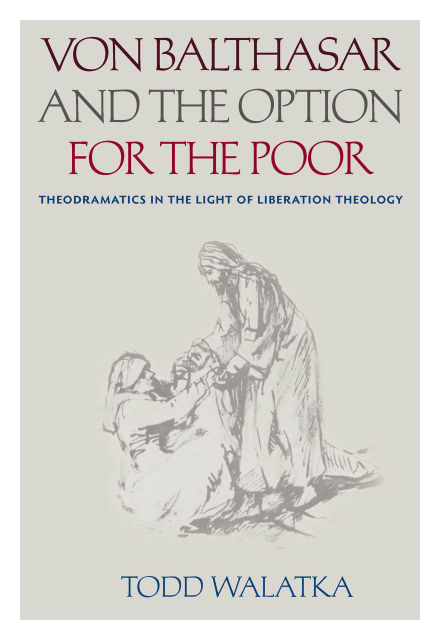 Our Freedom Within the Sovereign Freedom of God
I recently read Todd Walatka’s book, Von Balthasar and the Option for the Poor: Theodramatics in the Light of Liberation Theology. Balthasar’s concept of the living out of the drama of salvation, in which we are called to participate, seems to be closely related to the communitarian personalism that is so much a part of the Catholic Worker movement.
Balthasar teaches that every Christian must play a part in the drama of salvation. This role is urgent. Balthasar tells us: “Now that His word and example have been among us, active human love—individual and social, personal, and acting through structures—cannot be postponed.” What an encouragement to know that our humble efforts, joined with the Lord, may contribute to the salvation of the world and the carrying out of God’s plan.
According to Walatka, “Balthasar insists that at the core of existence, the human person has genuine freedom. Indeed it is only the presupposition of freedom that life is truly dramatic… But it is within the sovereign freedom of God that “Creation, the election of Israel, the incarnation, and hoped-for eschatological transformation of creation are ultimately grounded in the sovereign freedom of God.” (p. 107)
Both theodramatics and personalism emphasize the freedom of the human person within the plan of Divine Providence, to “decide for or against God and for or against the welfare of others” and to act on that decision. (Walatka, p. 95-96.)
Walatka shows that the cry of the poor and the call to reform structures is written into Balthasar’s theology, although not in detail. Walatka combines the teaching of Gustavo Guvierrez, Oscar Romero, Jon Sobrino and others to spell out the implications of Balthasar’s writings for social and political liberation for the poor of the world.
In his book, Walatka shares some important insights from the theologians of the South:
Gustavo Gutierrez: “Unless it stands against the forces of death, including persistent structural violence, terrorist violence of various kinds, and the violence of indiscriminate repression, the Church cannot be a visible sign and effective servant of life.” (p. 206)
Not mentioned in Walatka’s book, but a significant quote from Gutierrez’ book The Power of the Poor in History, challenges the Church and al of us: “The poor are a by-product of the system in which we live and for which we are responsible…. Hence the poverty of the poor is not a call to generous relief action, but a demand that we go and build a different social order.”
One of Walatka’s quotes from Oscar Romero reflects the preaching and writing of that great saint:
“This preference of Jesus for the poor stands throughout the Gospel. It was for them that he worked his cures and exorcisms; he lived and ate with them; he united himself with, defended, and encouraged all those who, in his day were on the margins of society, whether for social or for religious reasons: sinners, publicans, prostitutes, Samaritans, lepers. This closeness of Jesus to those who were marginalized is the sign that he gives to confirm the content of what he preaches: that the Kingdom of God is aet hand.” (p. 113)
Jon Sobrino points out that the drama of history toward the reign of God is not an easy path:
“History is marked by a struggle between the Kingdom and the anti-Kingdom, between the God of life and the idols of death; history is not “a simple onward human march without powerful forces of opposition.”
Walatka points out that “Sobrino sees the focus of the anti-Kingdom first and foremost as personal and structural realities that generate oppression, unjust violence, and outrageous inequality.…although Sobrino clearly recognizes moral ambiguity among the poor and the responsibility of perfectly distinguishing the just and the unjust in history.” (pp. 107, 187)
Walatka, with Balthasar, shows that the Church is a Sacrament of Salvation: “…once one recognizes in the social and structural forces resistance to oppression that are part of [the drama of salvation], the life of discipleship must be inclusive of social and structural resistance to oppression. Yet given that these are social forces arrayed against Christ in history, it is important that Christians face and oppose these forces as a social body—namely the Church.” (p. 200)
Pope Leo XIV – Dliexi Te – I Have Loved You
The option for the poor is an important teaching of the Magisterium. In his Apostolic Exhortation Dilexi Te, on Love for the Poor, Pope Leo XIV brings together the teaching and history, the great Tradition of the Church on God’s love for the poor, beginning with the history of Israel in the Old Testament, then featuring the teachings of Jesus in the Gospel, and the examples of the lives of the Saints in caring for the poor.
The Holy Father makes it clear that we cannot love the Lord without loving the poor. As he wrote in Dilexi Te: “Jesus’ teaching on the primacy of love for God is clearly complemented by his insistence that one cannot love God without extending one’s love to the poor. Love for our neighbor is tangible proof of the authenticity of our love for God… The two loves are distinct yet inseparable. (#26)
Together with the Latin American theologians, the Holy Father recognizes the unjust structures and economic policies that oppress the poor and asks us to change them. He makes it explicit that Catholic Social Teaching is not an optional add-on to our faith, but central to the way we live as Catholics.
“All the members of the People of God have a duty to make their voices heard, albeit in different ways, in order to point out and denounce such structural issues, even at the cost of appearing foolish or naïve. Unjust structures need to be recognized and eradicated by the force of good, by changing mindsets but also, with the help of science and technology, by developing effective policies for societal change. It must never be forgotten that the Gospel message has to do not only with an individual’s personal relationship with the Lord, but also with something greater: “the Kingdom of God “ (cf. Lk 4:43) [#97].
Each Person’s Destiny
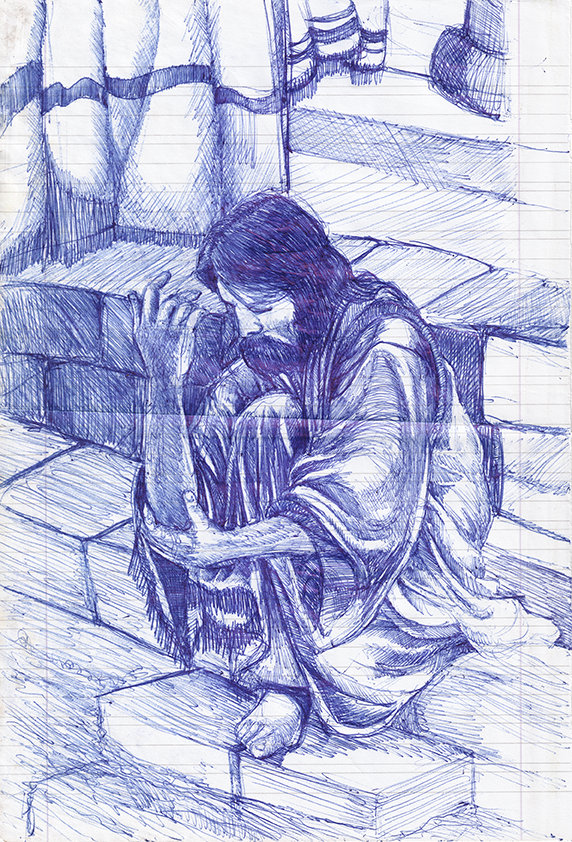
Artist: Angel Valdez
Peter and Dorothy recommended that our lives as Catholics be spent doing the 14 Works of Mercy instead of the works of war. The Catholic Worker Program emphasizes houses of hospitality for those in need, voluntary poverty, communitarian personalism, the way of non-violence, workers and scholars sharing and working together including manual labor and agriculture, study of early and late church theologians and the writings of the saints, and an economic system that serves all. Life at the Catholic Worker was undergirded by a participation in the liturgy, including at least some of the hours of the Divine Office, and spiritual reading.
At that time, as now, some said that the Church is oppressive. With Dorothy and Peter we find it to be the opposite, that it provides the faith, the strength, the ideas to live out the freedom of the Gospel. The example of Peter Maurin and Dorothy Day gives us permission to live in a different way at Casa Juan Diego together with others who come to share in our work of hospitality to immigrants and refugees.
The freedom we have been given is a great gift to create alternatives in the culture. Alternatives to institutions and bureaucracies which inhibit vocation and destiny. Alternatives to false gospels, such as the one which makes economics, wealth, and possessions the first religion, and turns love of country into an extreme ideology.
The more we read Dorothy, the more we realize she was Catholic to the core. Dorothy had more problems with the state than she had with the Church, as a matter of fact. She was very concerned about state control and preferred that individuals take responsibility for the poor instead of the government doing it. She always recommended that it would be better to listen to Holy Mother the Church rather than Holy Mother the state.
Many ask the question, how has the Catholic Worker been able to combine its spiritual outlook with its social witness in a way that testifies to the autonomy and priority of faith, yet remain fully engaged with the most difficult and controversial issues of public life? This was the genius of Dorothy Day’s Catholicism. The answer lies in her commitment to holiness and her commitment to the poor and workers.
The Catholic Worker was a sign of hope during the Depression and later during world wars. Its vision continues to provide a potential powerful witness from the Gospel.
We present to new Catholic Workers at Casa Juan Diego some examples of how we can live out our freedom as children of God. We are free to:
- Free to wash the feet of others
- Free to be poor, not to purchase expensive cars and houses and goods
- Free to turn the other cheek.
- Free to work to share burdens, free to share work in community
- Free to go the extra mile
- Free to give up all to serve
- Free to resolve conflicts without violence
- Free to make sure sick people get to see the doctor
- Free to work for economic and social justice
- Free to care for the stranger, the immigrant, the refugee
- Free to follow and live out the will of God
Dorothy and Peter presented a different view from the prevailing ideologies. They spoke of vocation, destiny. Rather than cutting the bonds that confine us, they said, we need to be attached to our destiny. They spoke of the primacy of the spiritual, of personalism, personally acting in the world, not always waiting for the government to act, but responding personally as Christians. They insisted that Matthew 25 and the Sermon on the Mount be taken seriously.
You all know Matthew 25. It is the only place we see in in Scripture that tells us how we are going to be judged on Judgment Day. In Matthew 25 (verses 31 and the following), our Lord says he will separate us into the sheep and the goats, sheep on the right and goats on the left. To those on the right he will say, Come ye blessed of my Father in heaven, into the kingdom prepared for you from all eternity, for it was you who gave me food, you gave me drink when I was thirsty, naked and you clothed me, sick and in prison and you visited me. And they will say, when, Lord, did we do that to you? And the Lord will say, what you did to the least of my brethren, you did to me. Those on the left were doomed to everlasting hellfire. It’s what happens to those who haven’t fed the hungry, clothed the naked, and visited the sick and imprisoned.
With our personal and theodramatic role in history, we hope not to be like the rich man who did nothing for Lazarus sitting at his gates, the rich man who hoped to be admitted to God’s heaven after ignoring the plight of the poor man at his gates. As the Scriptures tell us, if we ignore the cry of the poor, they may cry out to the Lord, and we will incur guilt.
May we all take the words of the prophet Zephaniah (2:3) as our guide:
“Seek the Lord, all you humble of the earth, who have observed his law; seek justice, seek humility; perhaps you may be sheltered on the day of the Lords’s anger.”
References:
Apostolic Exhortation Dilexi Te of the Holy Father Leo XIV to all Christians on Love for the Poor.
October 4, 2025.
Melissa Moschella, “He Who Spends Too Much Is a Robber”: Natural Law’s Stringent Norms Regarding
Ownership and Use of Property,” The New Ressourcement, Vol. 2, No. 4, Winter 2025,
Todd Walatka, Von Balthasar and the Option for the Poor: Theodramatics in the Llght of Liberation
Theology. The Catholic University of America Press, 2017.
Houston Catholic Worker, Vol. XLVI, No. 1.