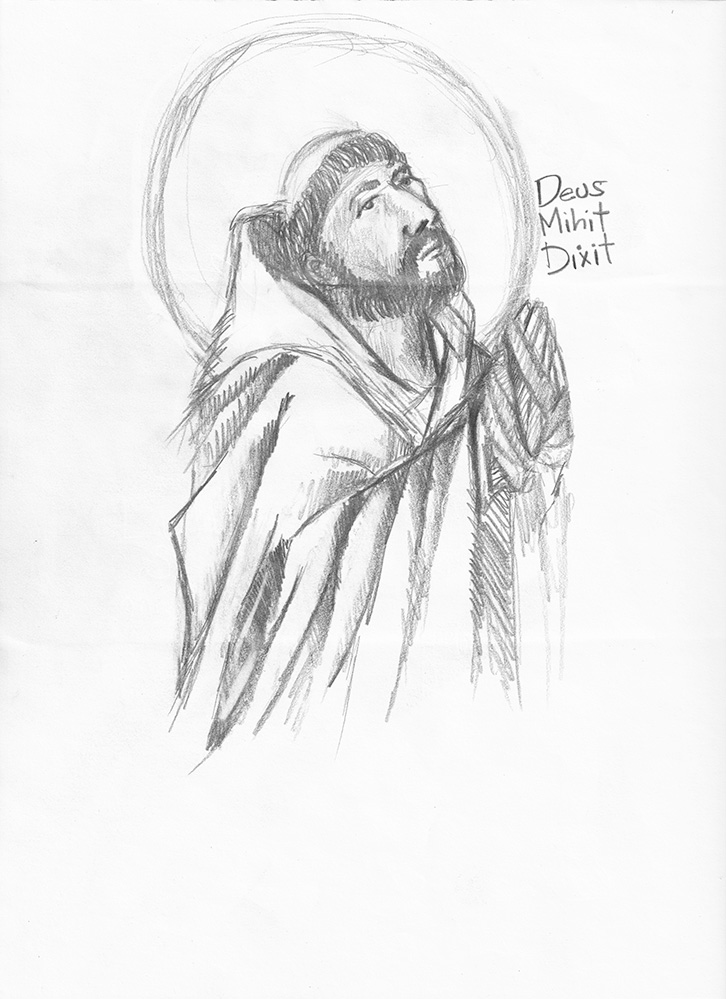
Artist: Angel Valdez
The proclamation of this year (2026-2027) as the Jubilee Year of St. Francis of Assisi is perfect timing as we face similar dangers that were present at the time when Francis lived – 800 years ago.
In a Jan. 10 letter to the ministers general of the Conference of the Franciscan Family, Pope Leo said St. Francis’ message of peace was needed now more than ever. “In this age, marked by so many seemingly interminable wars, by internal and social divisions that create mistrust and fear, he continues to speak. Not because he offers technical solutions, but because his life points to the authentic source of peace,” the pope wrote.
“That peace, “the pope added, “is not limited to the relations between human beings,” but extends to “the entire family of Creation.”
“This insight resonates with particular urgency in our time, when our common home is threatened and cries out under exploitation,” he wrote. “Peace with God, peace among human beings, and with creation are inseparable dimensions of a single call to universal reconciliation.”
Who is St. Francis of Assisi?
The name of St. Francis of Assisi is well known. Many important aspects of his life, however, are not well known. The St. Francis bird baths in people’s yards are often all that some may ever know.
He was a mystic, committed to a life of poverty and peace. Late in his life he received the stigmata. However he was not always so.
Francis was the son of a wealthy merchant. Like other youths that he knew, Francis longed to become a knight, and hoping to do great things, volunteered to fight in a war there in Italy. Many young men he knew were killed. Francis was a prisoner of war for a year under miserable conditions until his father ransomed him.
Francis became very ill and even bedridden after his time in prison. After he had somewhat recovered, Francis was on his way to go back to fight again. God, however, had other plans for him. The Lord, in a dream, told Francis to go back home that there were other plans for him.
As he waited in Assisi, Francis, discouraged and almost in despair, spent a lot of time in prayer especially in a nearby cave. Later, he was praying before a crucifix in the small abandoned church of San Damiano, when he heard the voice of Jesus speaking from the crucifix speak to him:
“Francis, go repair my church, which as you can see is in ruins.”
Saint Francis first interpreted that call as an invitation to reconstruct the ruins of the small chapel stone by stone, but in later years he came to understand the full meaning of the call. He was called to “to renew,” with a spirit of obedience, the Church itself.
Francis was totally changed by his encounter with the Jesus of the Gospels and in meeting the poor. He renounced his family and riches, the way of war, and lived a life of radical poverty and service.
As Mark Zwick wrote, “The world flocked to this Francis.
“In the midst of church and state corruption, little brothers and sisters emerged like flowers that rise out of dung heaps, springing up everywhere, crowding out the weeds of power and corruption.
“The little brothers and sisters abandoned all seeking of power–Francis relentlessly hunted them down if they didn’t–-to become powerful people of their time. They didn’t need guns (in fact, Francis forbade them to be soldiers).
” The fire of reform burned so strongly in Francis that people thought the Church would go up in smoke. Brother Leo would caution him, “Put yourself out, Brother Francis. Put yourself out before you burn up the world.”
“But Francis wanted to save the Church, not destroy it.
” He knew that the Church existed to make Saints in order to make the Church present in society.
“He changed the face of Europe without firing a single shot. His was a great reformation and like Attila the Hun he decided not to sack Rome to accomplish it.”
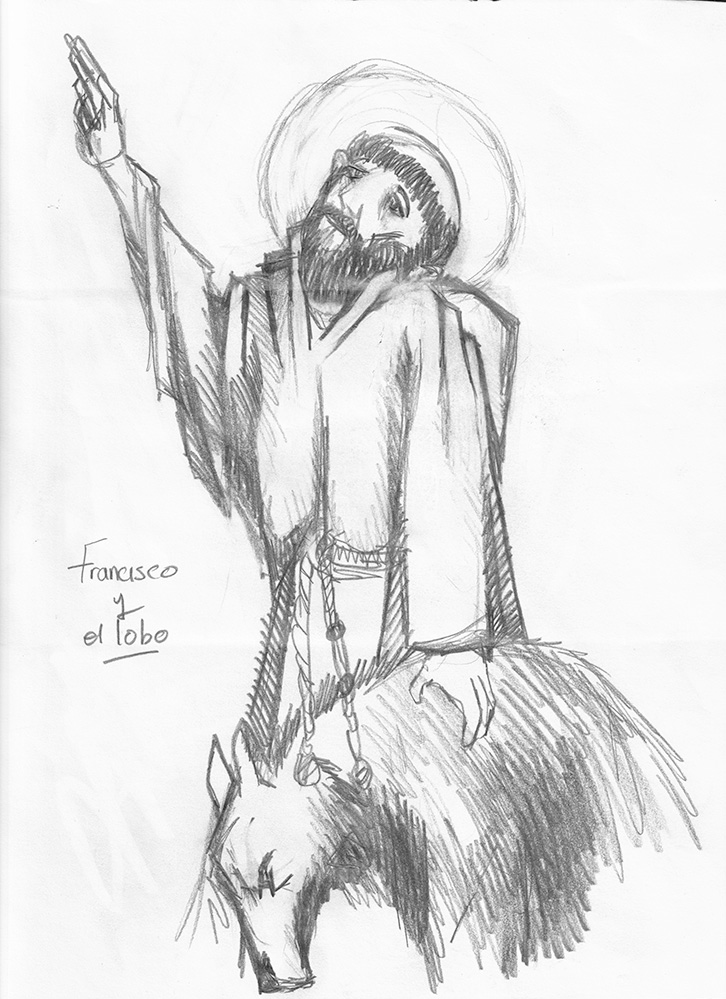
Artist: Angel Valdez
There are many stories of Francis, including his transformative encounter with the leper and his encounter with the wolf.
Peter Maurin’s Favorite Encyclical on St. Francis
When Peter Maurin first began to speak to Dorothy Day about his ideas for an apostolate for the world, one of the first things he pulled out of his pocket was the encyclical of Pius XI on St. Francis, Rite Expiatis. Dorothy and Peter and the early workers studied Rite Expiatis.
St. Francis was one of the important models for the Catholic Worker because of his radical commitment to the Gospel. The heart of the Worker movement, expressed in love and service of the poor, personalism, voluntary poverty, pacifism, and participation in manual labor had been brought to the world in a dramatic and unique way by St. Francis.
In Rite Expiatis Pope Pius XI described the world at the time of St. Francis and the way in which he transformed it:
“The terrible conditions existing in the times when St. Francis lived are well known.
“Although the Catholic faith still lived in the hearts of men, the charity of Christ had become so weakened in human society as to appear to be almost extinct. To say nothing of the constant warfare carried on by the partisans of the Empire, on the one hand, and by those of the Church on the other. The cities of Italy were torn by internecine wars…. Horrible massacres, conflagrations, devastation and pillage, exile, confiscation of property and estates were the bitter fruits of these struggles.
“Peace-loving people were harassed and oppressed with impunity by the powerful. Those who did not belong to that most unfortunate class of human beings, the proletariat, allowed themselves to be overcome by egotism and greed for possessions and were driven by an insatiable desire for riches. These men paraded their riches in a wild orgy of clothes, banquets, and feasts of every kind. They looked on poverty and the poor as something vile. They abhorred from the depths of their souls the lepers and neglected these outcasts completely in their segregation from society. What is worse, this greed for wealth and pleasure was not even absent, though many of the clergy are to be commended for the austerity of their lives, from those who should have most scrupulously guarded themselves from such sin.
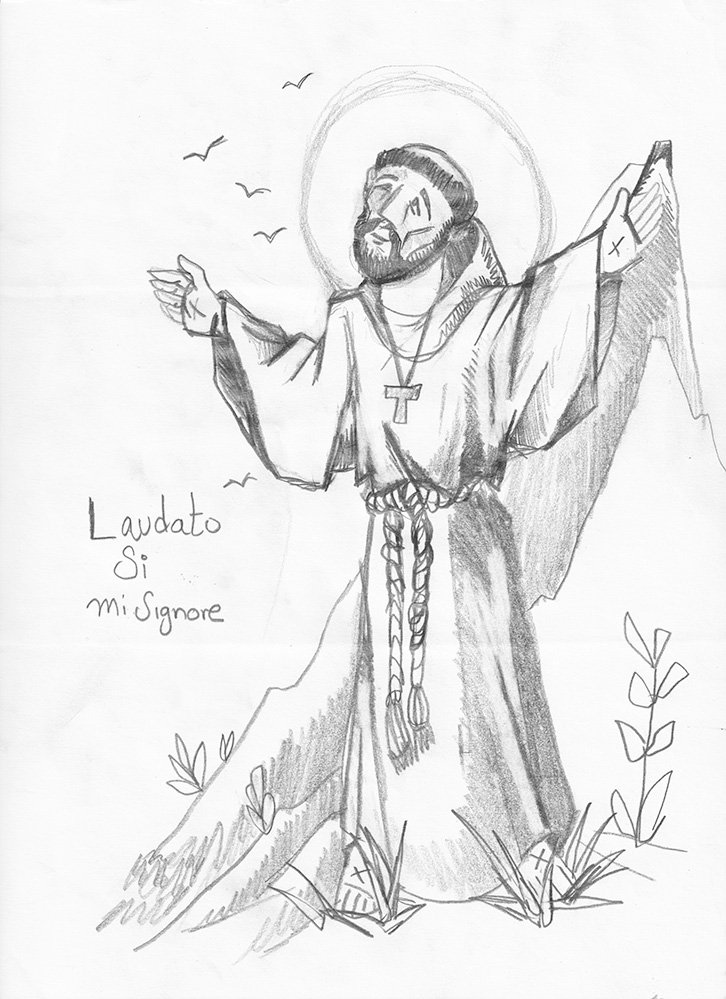
Artist: Angel Valdez
“To bring light to the people of this world which we have described, and to lead them back to the pure ideals of the Gospels, there appeared, in the Providence of God, St. Francis of Assisi.”
In the encyclical Pope Pius XI described the experience of St Francis:
“On a journey to Puglia on a military mission, Francis felt himself commanded by God in unmistakable terms to return to Assisi and learn there what he must do. After much wavering and many doubts, through divine inspiration and through having heard at solemn Mass that passage from the Gospels which speaks of the apostolic life, he understood at last that he, too, must live and serve Christ according to the very words of the Holy Gospels. From that time on he undertook to unite himself to Christ alone and to make himself like unto Him in all things.
“Let us now see with what exercise of perfect virtue Francis prepared himself to follow the counsels of divine mercy and to make himself a capable instrument for the reformation of society.
“It is not hard to imagine the love of evangelical poverty which burned within him. Everyone knows how he loved to befriend the poor, and how he was so filled with kindness that being “no mere hearer of the Gospel” he had decided never to deny help to the poor.
“On one occasion he was with a party of young men, singing in the streets after a banquet, when he stopped suddenly and, as if lifted outside himself by a wonderful vision, turned to his companions who had asked him if he was thinking of getting married and quickly replied, with some warmth, that they had guessed rightly because he proposed to take a spouse, and no one more noble, more rich, more beautiful than she could possibly be found, meaning by these words Poverty or the religious state which is founded on the profession of poverty. In fact, he had learned from Our Lord Jesus Christ Who, ‘although he was rich made Himself poor for us’ (II Corinthians 8:9) that we, too, should become rich by His poverty, which is, in truth, divine wisdom. For Christ has said: ‘Blessed are the poor in spirit; if thou wilt be perfect, go, sell what thou hast, and give to the poor, and thou shalt have treasure in heaven: and come follow me.’ (Matt. 5:3 and Matt. 19:21)
“Poverty, which consists in the voluntary renunciation of every possession for reasons of love and through divine inspiration and which is quite the opposite of that forced and unlovable poverty preached by some ancient philosophers, was embraced by Francis with so much affection that he called her in loving accents, Lady, Mother, Spouse.
Did St. Francis have PTSD?
Recent studies have brought to our awareness the ways in which St. Francis suffered during and years after his time in jail as a prisoner of war. Some Franciscan military chaplains have shared the struggles of St. Francis to help them cope with PTSD after traumatic experiences in war. Even though Francis’ father eventually ransomed him, some accounts show that he had contracted a grave illness from the inhumane treatment he received. Francis, who loved the earth and the sky, all of God’s creation, was unable to appreciate its beauty in his despair during his time of recovery after war and imprisonment.
Fr. Conrad Targonski, one of the Franciscans who shares with veterans about the sufferings of St. Farncis, wrote in an article in St. Anthony Messenger:
“Francis carried mental wounds from the trauma of war and imprisonment.” “He had the memories, he had the dreams, he had the flashbacks.” In spite of this Francis was able to do great things united with the Lord.
Message and Prayer from Pope Leo XIV for the Jubilee Year of St Francis
“In this Year of Grace, I wish to offer you a prayer that Saint Francis of Assisi may continue to instill in all of us perfect joy and harmony:
Saint Francis, our brother, you who eight hundred years ago went to meet Sister Death as a man at peace, intercede for us before the Lord.
You recognized true peace in the Crucifix of San Damiano, teach us to seek in Him the source of all reconciliation that breaks down every wall. You who, unarmed, crossed the lines of war and misunderstanding, give us the courage to build bridges where the world raises up boundaries. In this time afflicted by conflict and division, intercede for us so that we may become peacemakers: unarmed and disarming witnesses of the peace that comes from Christ.
Amen.”
Recommended Reading
Murray Bodo, Francis: The Journey and the Dream, St. Anthony Messenger Press, 1988.
G. K. Chesterton, St. Francis of Assisi. Hodder and Stoughton,1923.
The Little Flowers of St Francis. Introduction by Madeline L’Engle. Penguin Random House. 1971.
Paul Moses, “A Suffering Saint: Francis of Assisi’s Shadow Side,”Commonweal, October 4, 2011
Pope Pius XI, Rite Expiatis, Encyclical on St. Francis of Assisi.
Katie Rutter, “St. Francis: Giving Comfort to Weary Soldiers,” St. Anthony Messenger , Nov. 2021.
Mark and Louise Zwick: “St. Francis: Saint of Voluntary Poverty and Nonviolence” in The Catholic Worker Movement: Intellectual and Spiritual Origins. Paulist Press, 2005.
Archdiocesan Pilgrim Site for the Jubilee Year of St. Francis in Houston
St. Francis of Assisi Parish
5102 Dabney St.
Houston, TX 77026
713-672-7773
www.stfrancishouston.org
Houston Catholic Worker, Vol. XLVI, No. 2, April-June 2026.