 In all of its history the Catholic Church has declared a total of only 37 men and women to be Doctors of the Church, saints who are recognized for their outstanding contribution to the understanding and interpretation of the sacred Scriptures and the development of Christian doctrine.
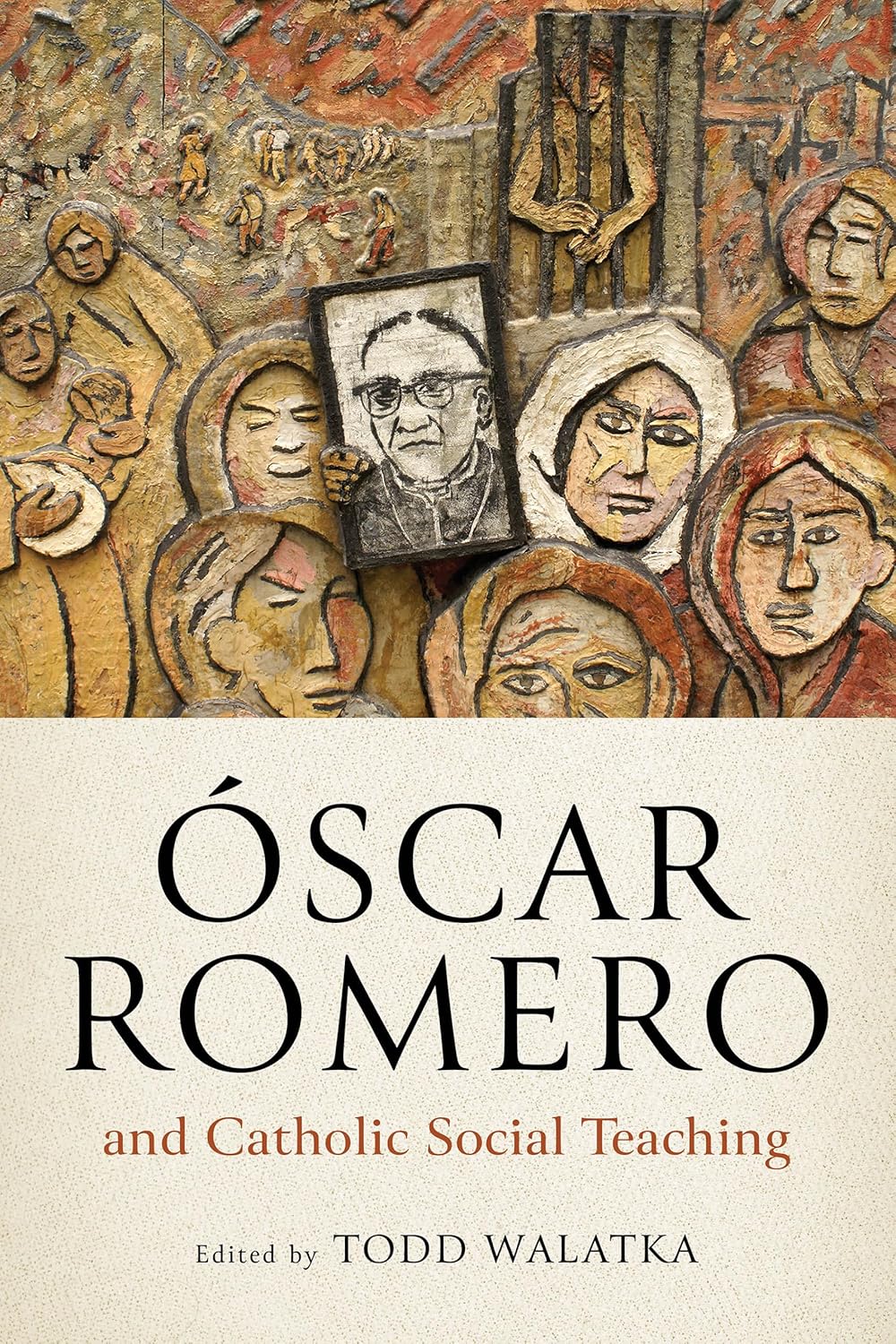
In 2018 when Archbishop Alas of San Salvador asked that Monseñor Romero be named a Doctor of the Church, the Houston Catholic Worker, along with various others, echoed that call and recommendation. A new book, Óscar Romero and Catholic Social Teaching from Notre Dame, continues and deepens the call to add Romero’s name to the list of illustrious Doctors of the Church.
This book, edited by Todd Walatka, brings together the work of 14 outstanding theologians to document the history, legacy, and development of Catholic Social Doctrine in El Salvador in the prophetic teaching and witness of Archbishop Óscar Romero. Its authors recount the way Romero, at first not a big advocate of the social reforms recommended at the Latin American Bishops’ Conferences at Medellin (1968) and Puebla (1979), studied CST in the Bible, the documents of the Second Vatican Council, the encyclicals (especially those of Pope Paul VI) and the documents from Medellin and Puebla and included them in his preaching and teaching. (Romero was martyred in 1980 as he celebrated Mass).
Were Saint Óscar Romero to be declared a Doctor of the Church, a Doctor of the Development of Catholic Social Teaching, the world’s Catholic bishops would not only be authorized, but also encouraged more than ever, to implement this doctrine in their dioceses and parishes and be sure that seminarians integrate the doctrine into their studies. Such a designation could help Catholics to avoid overemphasizing one church teaching to the neglect of others, as has sometimes happened.
So Much More Than a List of Principles
Several years ago, a Catholic woman who was committed to working for social justice came to ask young volunteers at Casa Juan Diego: “Do you know the five principles of Catholic Social Teaching?” When they said no, or looked bewildered, she would give them a list of the principles. It seemed, however, that such a list of abstract principles (important as they are) did not reach the hearts of those who heard the list.
It is frequently said that Catholic Social Teaching is one of the best-kept secrets of the faith. That may be true. Some even suggest that it is ineffective and not really implemented. Perhaps one of the reasons is that what is lacking are concrete examples of how this teaching can be incarnated, made real by living out the Gospel in history. It would provide an incredible example for Catholics to have a Doctor of the Church who studied Church documents on Catholic Social Doctrine and implemented it in very difficult circumstances.
Chapter 2 of Pope Leo XIV’s encyclical Magnifica Humanitas not only lists and explains the foundations and principles of Catholic Social Doctrine, but also applies them to current realities, especially including AI.
Even some who have been emphasizing the principles of Catholic Social Teaching may not have in their consciousness that resistance, persecution and repression – even martyrdom, as in the case of Romero, may follow challenges to economic and social systems that harm the poor.
As Archbishop Romero said in his homily of July 16, 1978, “To abide by the teachings of the Holy See, of the magisterium, to speak highly of them, to praise them, to defend them theoretically, is very easy, but when it means incarnating that teaching and giving it life in a diocese, in a community, and identifying the concrete facts that are opposed to this teaching, then come the conflicts.” (p. 60)
Catholic Social Teaching in Latin America
The Latin American Bishops’ conferences at Medellin and Puebla that addressed CST were followed by years of development of small basic ecclesial communities based on the method developed by Cardinal Joseph Cardijn years before, known as “See, Judge, and Act.” That method, which asks small group participants to look at realities around them, reflect on related Scripture passages, and determine actions in response, was enshrined in the Magisterium by John XXIII in his encyclical Mater et Magistra. Countless small comunidades de base throughout Latin America heard the Gospel in these groups, talked together, and acted. In addition, educational programs of literacy and conscientization of the poor and large numbers of cooperatives among poor farm workers flourished throughout Latin America in the 1960’s and 1970’s. These efforts were strongly supported by Archbishop Chavez, Oscar Romero’s predecessor in San Salvador, paving the way for Romero’s further implementation of Catholic Social Doctrine.
Growing into Catholic Social Teaching in History

Oscar Romero
Romero spent many years of his priesthood in administration. During the early 1970s his positions seemed to echo those who questioned the profound changes happening across Latin America (p. 55). His theology of Catholic Social Teaching rooted in magisterial documents deepened and developed after his earlier questioning of the more liberationist expression that had emerged.
Ana María Pineda, R.S.M, points out that it was when he was made bishop of Santiago de María in 1974 that Romero came into close contact with the poor, especially campesinos. She quotes from James R. Brockman’s book, Romero: “He discovered that after toiling in the coffee plantations, the workers returned to the fields to sleep. They had no other place to rest, nor did they earn enough to nourish themselves well after a long day of work. Recognizing their needs, Romero opened up the cathedral for the men and made sure they had warm beverages. Then he spent time there with them as they recounted their grim situation.” (p. 28)
Matthew Whelan recounts that already in 1974, Romero displays his deepening engagement with Catholic Social Teaching: “Drawing on Pope John XXIII’s Mater et Magistra and Paul VI’s Octogesima Adveniens, Romero systematically critiques El Salvador’s agrarian structure which he characterizes as divided between an elite group of wealthy landowners, on the one hand, and a permanent class of underpaid workers forced to migrate to find work, on the other.” (p. 87)
Those who cried out about inequalities and asked for justice for poor campesinos were accused of being Marxists. David M. Lantigua explains that “although Romero condemned atheistic communism in the spirit of Catholic Social Doctrine, he always relied on the Salvadoran reality to inform his prophetic denunciation of the two divinities destroying the Christian concept of human dignity in his country: the god of power under national security and the money-god under liberal capitalism.” (p. 159)
Stephen J. Pope describes the situation: “In the early 1970s, a small number of very wealthy families owned 60 percent of the arable land in El Salvador. Most of the country’s income was generated by commercial export of coffee, cotton, and sugar cane… Poverty, landlessness, unemployment, underemployment, and exploitation led to high levels of hunger, malnutrition, and disease.” ((p. 200)
Wealthy landowners reacted to movements to educate and conscientize the landless poor by intimidation and repressive violence. The landowners and others of the wealthy classes were supported by government authorities as violence grew. Death squads roamed the land killing those who raised questions about that which oppressed the people.
The situation was a new colonialism – implemented by wealthy Salvadorans, but supported and funded by outsiders, especially the United States.
As repression and violence increased against those who participated in the popular movements, missionary priests who worked with the people to implement Catholic Social Teaching were deported; a growing number of Salvadoran priests were killed.
The Sinfulness of Absolutizing Wealth and Private Property
One of the principles of Catholic Social Doctrine is the Universal Destination of Goods. In other words, God created the world for all. St. Thomas Aquinas defends ownership of private property, but with the stipulation that it must be used for the common good – the private owner of property is only God’s trustee on earth of that which really belongs to God.
In his fourth pastoral letter, Misión de la Iglesia en Medio de La Crisis del País of August 1979, Romero called out three “idolatries”: the absolutization of wealth, which emphasizes “having more”, and not “being more”: the absolutization of the idea of private property, when the wealth of the few increases while the poverty of the masses worsens; and finally, the idolatry of political power which conspired with the other two to form the root of structural and repressive violence.
Romero on Comunidades de Base
Archbishop Romero came not only to appreciate the small basic Christian communities, but also recommended them for all Catholics. According to Michael E. Lee, “Romero saw the base communities as representing the basic unity of the church: ‘Small communities where reflection on the gospel, the life of love, Christianity, the communitarian life, is made more human, closer. All Catholics today are called to collaborate in this form.’ Romero saw how the CEBs embodied his vision for what real church life should look like and the conscientization that all believers should undergo. For they have ‘that dialogue that makes the parish more intimate, and is disgracefully interpreted as subversion, as simply entering into politics. It is the maturation of faith that we are seeking, to awaken the sense of human dignity, of the family, to tell people to seek that themselves, live their proper destiny constructed by their own efforts.’” (p. 60)
Courage
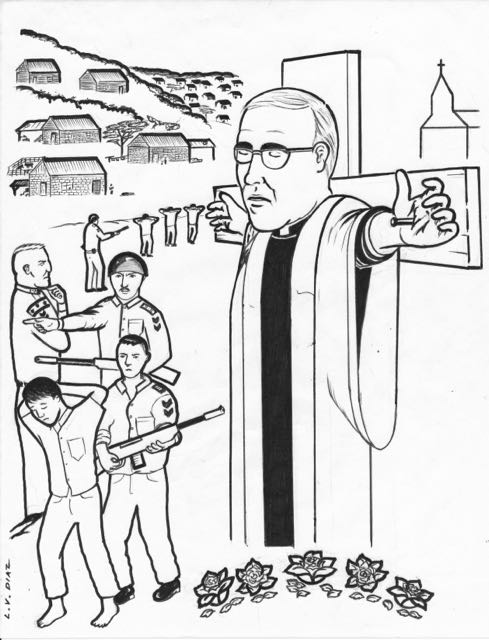
Artista: L. V. Diaz
Romero faced the realities of his time with much courage. In his book on the virtues, Romano Guardini features the virtue of courage, especially the courage to take a risk if it is God’s will:
“Each situation is a call, for it addresses us and says, ‘Do this—do not do that!’ Again and again, we are faced with the decision to dare to tell the truth or to lie, to be just or to seek our own advantage…. On each occasion, God calls us.
“Here courage means placing our hand in His and following Him, in small things and in great. The way may lead us very far. We know of persons who follow it so far that they escape our comprehension; these are the saints. We hear them speak, we read their writings, they have gone beyond us, with God. If there is a regret which is most bitter at life’s end, it is this: I heard the call but did not follow it.”
Óscar Romero did not stop preaching and teaching about Catholic Social Doctrine even though he knew he might face martyrdom. He took the risk.
He said: “Christ invites us not to fear persecution because, believe me, brothers [and sisters], the one who is committed to the poor has to face the same fate as the poor. In El Salvador we know what it means to share the same fate as the poor: be among the disappeared, tortured, imprisoned, to turn up as corpses.” (p. 319)
What about the Future?
In Pope Leo’s encyclical Magnifica Humanitas he said: “Today, the Social Doctrine of the Church is a legacy of wisdom, where we find principles for thought, criteria for discernment and judgment, and concrete guidelines for action. Founded on Sacred Scripture and Tradition, and in engagement with the sciences, it helps us clearly interpret the challenges of the present and identify appropriate ways for living out a clear Christian witness, with joy and in service to the world. It is not an inert set of concepts, but a living corpus of truth that safeguards and interprets humanity’s vocation to a full and just life.
“Building a world in which everyone can flourish requires shared responsibility and courage. No one can single-handedly bear the weight of the challenges the world is facing, just as no one is so weak that they cannot play their part, for ‘power is made perfect in weakness’” (2 Cor 12:9).
Pope Leo, quoting Tolkien. shows us how we all can participate in bringing the Gospel to this moment in history, as Archbishop Romero did in his, through the application of Catholic Social Doctrine:
“The twentieth-century Catholic author J.R.R. Tolkien, in the words of a protagonist in one of his novels [Gandalf], described our responsibility in this way: ‘It is not our part to master all the tides of the world, but to do what is in us for the succour of those years wherein we are set, uprooting the evil in the fields that we know, so that those who live after may have clean earth to till. The civilization of love will not arise from a single or spectacular gesture, but from the sum total of small and steadfast acts of fidelity that serve as a bulwark against dehumanization’.” (The Lord of the Rings; The Return of the King).
Recommended Reading
Leonard J. DiLorenzo, “Why Tolkien’s ‘The Lord of the Rings’ is a Catholic Journey,” OSV News, May
27, 2026
Romano Guardini, Learning the Virtues. Sophia Institute Press.
Oscar Romero. A Prophetic Bishop Speaks To His People; the Compete Homilies of Archbishop Oscar Arnulfo Romero. 6 Vols., Convivium Press, 2015.
Oscar Romero. Voice of the Voiceless: The Four Pastoral Letters and Other Statements. Orbis Books, 1985, 2020.
Todd Walakta. ed. Óscar Romero and Catholic Social Teaching, University of Notre Dame Press, 2024.
Houston Catholic Worker, Vol. XLVI, No. 3, July to September 2026.