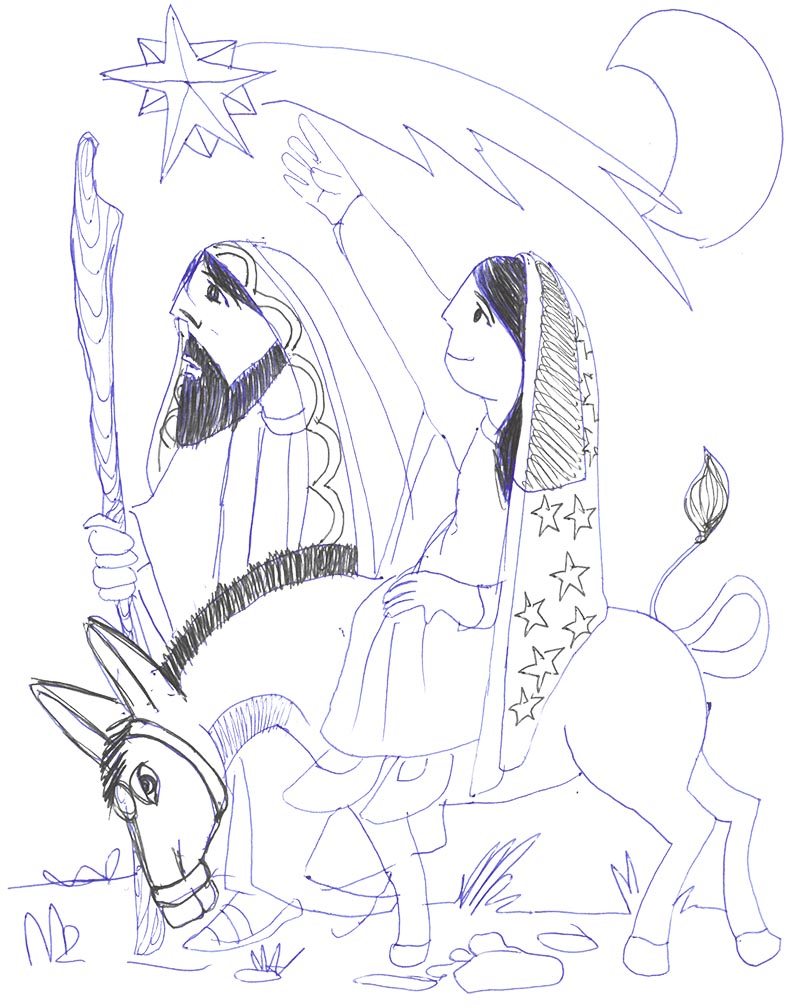
In the Incarnation, Jesus came to bring the Reign of God. He announced:
The Spirit of the Lord is upon me,
because he has anointed me
to bring glad tidings to the poor.
He has sent me to proclaim liberty to captives
and recovery of sight to the blind,
to let the oppressed go free. (Luke 4:18-19)
We think of the joy of the angels and the shepherds on that wonderful night when the child Jesus was born. The story moves all of our hearts and inspires us to become more committed disciples of the Lord.
The recounting of the beauty of the Christmas story now, however, is marred by the very difficult experiences of so many in today’s world. Influential people in economics and politics seem to have missed the message about glad tidings to the poor.
Instead of seeing those who struggle to survive through the eyes of Jesus, the poor are often maligned as simply lazy, unwilling to work or unable to manage their affairs. In most cases their poverty has not come about because people are lazy or not hard working. In the Global South (which includes many who already live in the U.S., including poor white citizens), those on the margins are not able to compete in the merciless market. Unlivable, unaffordable conditions and/or war drive millions of people from their home countries.
As I was writing this, four women arrived pleading for help because their husbands had been deported. With the breadwinner gone, they had no way to pay the rent. One told a Catholic Worker that she almost took her own life, but the presence of her small son deterred her. The very sick and injured come each day.
Then the Border Patrol and a Deportation Office called to ask us to receive families that needed a place to stay. Our halls resound with many languages, not just Spanish, Portuguese or French, but Chinese, Thai, and German.
We are able to help those who come to us because our readers make our Works of Mercy possible with their donations. However, the numbers of those in need are staggering.
In the Aims and Purposes of the Catholic Worker Movement, Dorothy Day reminded us that the prayer that Jesus taught us to pray asks, “Thy Kingdom come, thy will be done on earth as it is in heaven.”
We see the reality on earth formed not so much by the way Jesus spoke of the Kingdom of God and how his followers could help to bring it about, but by a pervasive economic worldview that is in opposition to the Incarnation and makes life difficult for many. Jesus and his vision of the Reign of God are replaced by a false idol – the market.
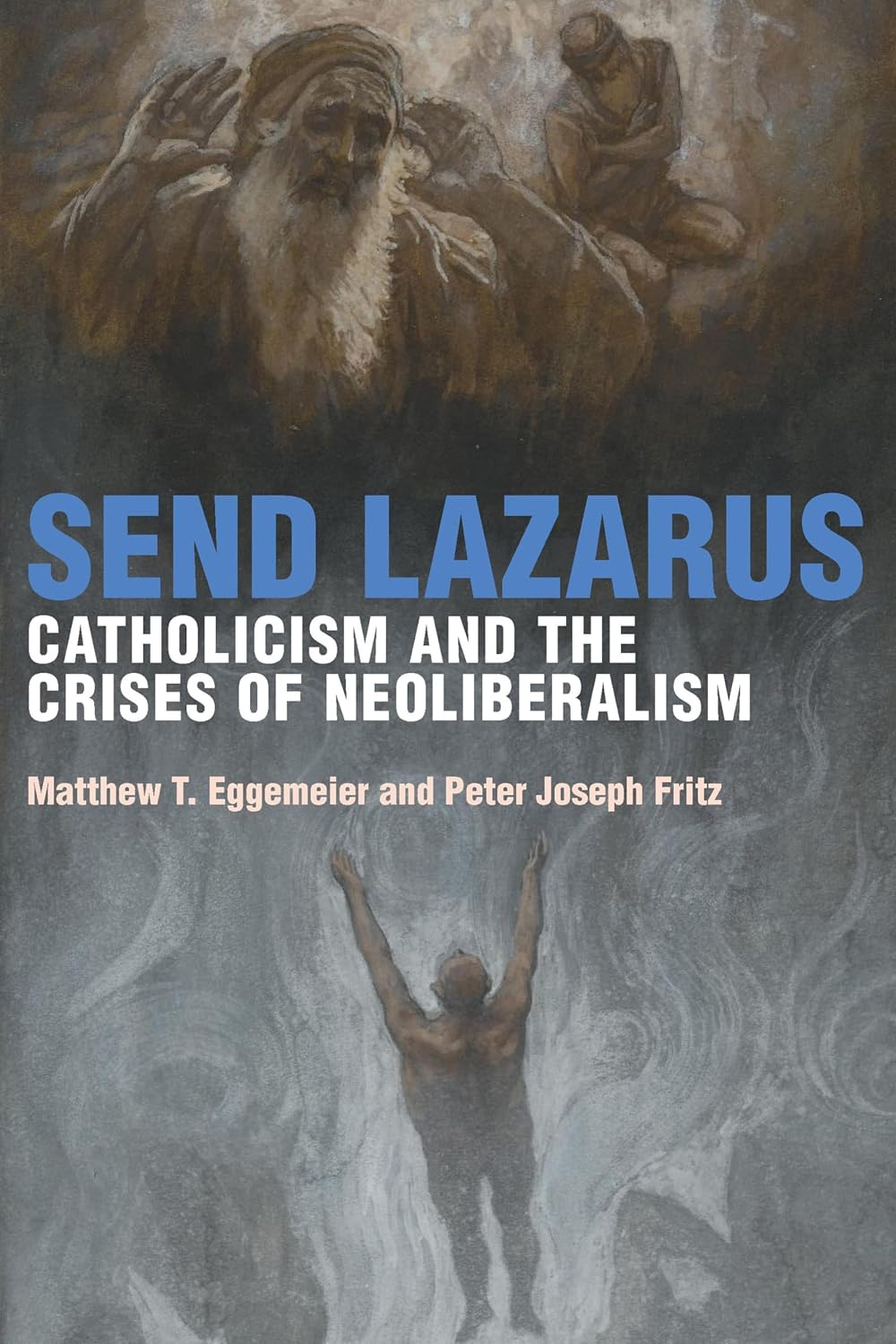 Send Lazarus: Catholicism and the Crises of Neoliberalism
We know the story of Lazarus from the Bible, the poor man with sores all over his body who begged outside the home of a very rich man. And we know the story Jesus told of what happened to the rich man who had ignored the poor when the rich man later came to the throne of God. He begged that Lazarus be sent to warn his brothers so that they would not suffer a similar fate.
In their book Send Lazarus: Catholicism and the Crises of Neoliberalism, Matthew T. Eggemeier and Peter Joseph Fritz, demonstrate how the market mentality which infects our culture should remind us of Lazarus and the rich man. They present neoliberalism (the economics that affects us all) and Catholicism as rival, incompatible systems:
“Neoliberalism has comprehensive intentions… it aims to marshal the whole of life toward markets or market logic. Neoliberalism’s drive toward comprehensiveness places it starkly at odds with Catholicism. Catholicism’s comprehensiveness obtains all things for Christ. Neoliberalism claims all things for the market.”
The contrast with the Gospel is so great that these authors contend that one can be neoliberal or one can be Catholic, but not both.
The Works of Mercy Reimagined
The proposal of Send Lazarus is a renewed understanding and implementation of the Works of Mercy, reimagined for our time. We must, the authors say, contest neoliberalism, but mercifully. “One who understands both neoliberalism and Catholicism is faced with a decision between them, between sacrifice and mercy, callousness and love, the rich man and Lazarus.” The authors present strategies for each of the fourteen Works of Mercy to address structural problems created by this economy. The contrast is clear: “Neoliberalism devalues the human person and disdains creation by callously sacrificing them to the impersonal Market. Catholics must turn against this system by enacting a politics of mercy, modelled on God’s creativity, Christ’s saving love, and a Spirit-enlivened spiritualty of structural transformation.”
What is Neoliberalism and Why Is it in Opposition to the Reign of God?

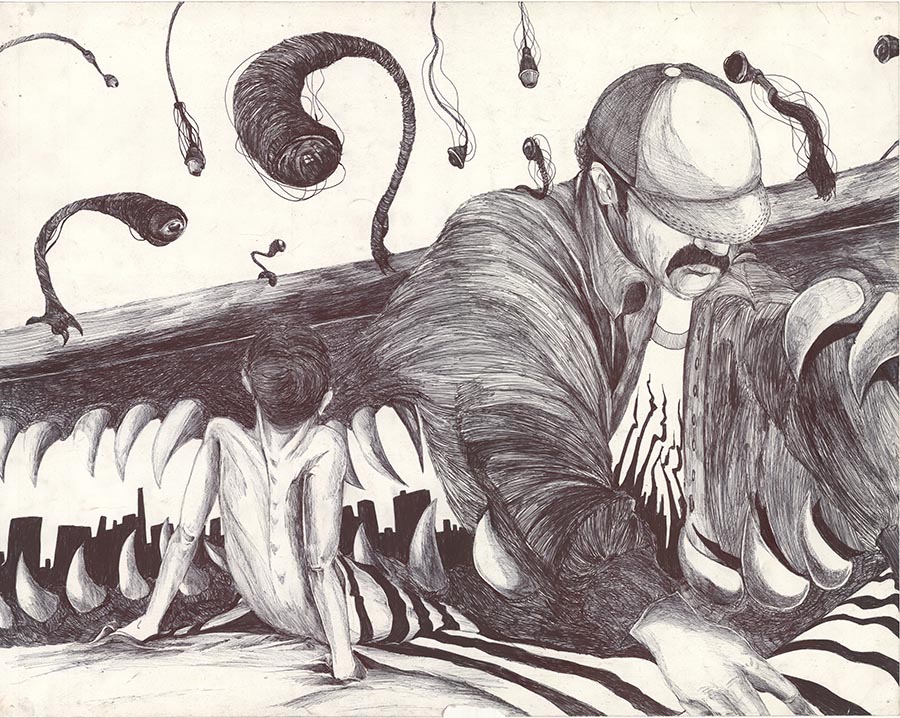
Artist: Angel Valdez
According to the authors of Send Lazarus, neoliberalism is a mutation of the most brutal capitalism, in which the state’s primary function is to foster market processes. Government must protect “the market,” rather than the people. The needs of the people of the earth are secondary to those of capital. This market doctrine is presented as a system which will create a utopia if its demands are followed. The “utopia,” however is for a few; others are discarded.
Neoliberalism presents itself as the “free” market pretending that it is in favor of small government. But it is not free and it does not want small government. It depends on massive government intervention in favor of the Market and corporations. Economic growth is the measurement key for countries, evaluated by how much the wealthiest become wealthier.
In this ideology, the meaning of the tradition of private property has been changed to represent capital (money) as opposed to land, tools, practical property. (St. Thomas Aquinas always conditioned teaching on private property by the generous and responsible use of that property.)
Theorists and powerful players in today’s economy change the definition of the human person into “human capital,” something to be used and easily exploited or discarded by market managers. Corporations have been given the legal status of “persons.” People are expected to look out for themselves without the protection of organized labor or any institutions or policies that prioritize the people. Efforts to respond to the needs of ordinary people are condemned by the use of the “S” word – socialism.
Some Reject Even the Mention of Social Justice
Some who consider themselves good Catholics scoff at the idea of social justice, considering it almost a Communist plot. Those who should be following the Gospel of Mercy and teaching others to do the same, are tricked into valuing the measurements of the market over the Lord’s teaching in the Beatitudes, the Sermon on the Mount and the parables, seeing the Gospel as impractical.
Average people in the United States and other rich countries are often in survival mode themselves in a not very affordable economy. Those who are killed in body and spirit by the global economy inhabit two-thirds of the world and are often invisible as people here go about their daily lives, trying to manage.
Our citizens do notice that the architects of the prevalent economy grow incredibly richer by the day as middle class people and the poor struggle. They do notice when through brutal tactics immigrant individuals and families are detained, incarcerated, and deported or even assassinated. They do notice that it appears that governments believe that their job is to benefit the economy, not their fellow citizens.
Christmas and the Reign of God, but What About the Poor?
The celebration of Christmas should echo the Lord’s words about bringing glad tidings to the poor, those considered “losers” by the winners in the market.
Artist: Angel Valdez
The cruelty of the market has horrific practical consequences. The “losers” or those who appear to be different from the powerful disappear through mass incarceration, mass deportation, development of slums, homelessness. The destruction of the planet grows while the market advances. Imagine how those deported to Haiti without a penny may celebrate Christmas this year.
The poor of the world have been made poorer by this economics. For decades, the muscle of the World Bank and the Internation Monetary Fund has ensured that the poor countries are “losers” economically. To avoid default on loans which were made to poor countries after World War II, the countries were forced to accept new terms for credit. This process was called structural adjustment. The conditions enforced on poor countries included interest being raised substantially on already existing loans, the dismantling of labor unions, and privatization of government services. NAFTA, under the guise of providing jobs in poor countries, but favoring corporations who profited from the cheapness of the labor, increased exploitation of labor and required countries to accept U. S. products that compete against local products. When the exportation of U. S. corn into Mexico happened with NAFTA, massive numbers of Mexican farmers were uprooted. Many came to the U.S. to try to find work.
Any countries who have refused to go along with structural adjustment for the benefit of U. S. companies have suffered invasion from the CIA (Chile, etc.). United States’ interventions have been defended in the name of stopping Communism. The ideas of economic and military interventions used to be called neoconservatism in the U.S., while all the world knew it as neoliberalism.
A Crucified People; The Prophetic Wisdom of Ignacio Ellacuría, SJ
This article was first inspired by an article in Theological Studies by Amirah Orozco, “The Reign of Neoliberalism and the Reign of God: Ignacio Ellacuría’s Anthropology as a Critique of Neoliberalism.”
In applying the anthropology of Ellacuría to the merciless economy today, Orozco shows that for those formed by the market, the concept of sin, especially against the poor, is unintelligible. “The common good can only be seen in terms of the ahistorical market. The people, animals, rivers, trees, and others sacrificed to the market are not visible in such a landscape.”
Orozco’s insights, along with our many encounters with immigrants and refugees at Casa Juan Diego, help us to understand why Pope Francis said, “This economy kills!”
Ellacuría: “Some actions kill (divine) life, and some actions give (divine) life; some belong to the reign of sin, others to the reign of grace.” He shows us the way of following the divine life of the Trinity here on earth: “The opposite of sin is working toward a historical reality that aligns with the coming of the reign of God… The poor’s living conditions are the objective reality of sin as the opposite of grace.”
Orozco quotes Ellacuría on what he refers to as the crucified peoples of history: “Ellacuría says that a large majority of the world lives in conditions that are due to ‘a social order that must be regarded as sin… ‘ The death of the poor is the death of God, the ongoing crucifixion of the Son of God. The crucifixion, like the conditions of poverty of a significant global population, plays out in the drama of salvation as s moment of sinful rejection of God.”
Fr. Ellacuría was assassinated in El Salvador in 1989, along with several other Jesuits and two lay women. Perhaps it was not surprising that an authoritarian government representing the rich and powerful would kill a professor for his ideas. Ellacuría, like Óscar Romero, taught that theology cannot be left in the abstract but must be alive and practiced in history. His theological and practical critique of the persecution and martyrdom of the poor of El Salvador and the world brought about his own martyrdom.
Ignacio Ellacuría’s Profound Understanding of Matthew 25
In his essay on the Crucified People, Ellacuría wrote of them in terms of Matthew 25:31-46 in the Bible, the part in the Gospel about Judgment Day when the Son of Man will come in his glory to judge the nations: “It is the judgment of the Reign, the universal and definitive judgment, that brings to light God’s truth among human beings; this truth is in the identification of the Son of Man, become King, with the hungry, the thirsty, wayfarers, the naked, the sick, and prisoners.
“The Son of Man is he who suffers with the little; and it is the Son of Man, precisely as incarnate in the crucified people who will become judge. In its very existence the crucified people is already judge, although it does not formulate any theological judgment, and this judgment is salvation, insofar as it reveals the sin of the world by standing up to it; insofar as it makes possible redoing what has been done badly; insofar as it proposes a new demand as the unavoidable route for reaching salvation.
“This is, lest we forget, a universal judgment in which sentence is passed on the whole course of history. Matthew 25 tells us that the Jesus of history has been poor, yet it is he who helps the poor. Jesus appears as the Son of Man, who suffers in the wretched of the earth, yet it likewise the Lord, who comes to their aid.”
“Thus, the crucified people has a twofold thrust: it is the victim of the sin of the world, and it is also bearer of the world’s salvation.” Mysterium Liberationis (p. 603)
The Message of the Popes
Recognizing what Catholics and others of good will are facing, Pope Leo XIV said this summer: “Against the false realism that re-arms minds, words, and nations, Catholic culture today must set the realism of mercy, in which there can be no enemies, and all people, even adversaries, are brothers and sisters to be looked in the eye and encountered in truth.”
Pope Leo calls for the exposure of “unjust power relations” that lie “at the root of poverty and inequality, war and environmental disasters.” He speaks of an “idolatry” that presents political or economic projects as bearing the hallmark of freedom, when instead they are really “enslaved to idols and power.”
The Holy Father said, “The Catholic vision and culture of love and mercy must overcome.”
The Reign of God
As we work toward a better world, may we remember the words of Pope Francis where he evokes the Good Samaritan and the parable in which Jesus the Judge announces his presence in the least of these:
“The Lord will say to you: But you, you remember that time on the road from Jerusalem to Jericho? That man was half dead. Do you remember him? That hungry child was me. Do you remember? The migrants that many want to drive out, it was me. Those grandparents alone, abandoned in nursing homes, it was me. That sick person alone in the hospital, that no one goes to see, it was me.”
References:
Kevin F. Burke, SJ, The Ground Beneath the Cross: The Theology of Ignacio Ellacuría. Georgetown University Press, 2000.
Matthew T. Eggemeier and Peter J. Fritz, Send Lazarus: Catholicism and the Crises of NeoliberalismFordham University Press, 2020.
Ellacuría, SJ, and Jon Sobrino, SJ.. Eds. Mysterium Liberationis: Fundamental Concepts of Liberation Theology, Orbis Press, 1993.
Amirah A. Orozco, “The Reign of Neoliberalism and the Reign of God: Ignacio Ellacuría’s Anthropology as a Critique of Neoliberalism,” Theological Studies 2026, Vol. 87(1) 76.
Mark and Louise Zwick, “Pope Benedict XVI Insists: No Structural Adjustment Related to Forgiveness of the Foreign Debt. But What Is Structural Adjustment?”
Houston Catholic Worker, Vol. XXVI, No. 1, January-February 2007.